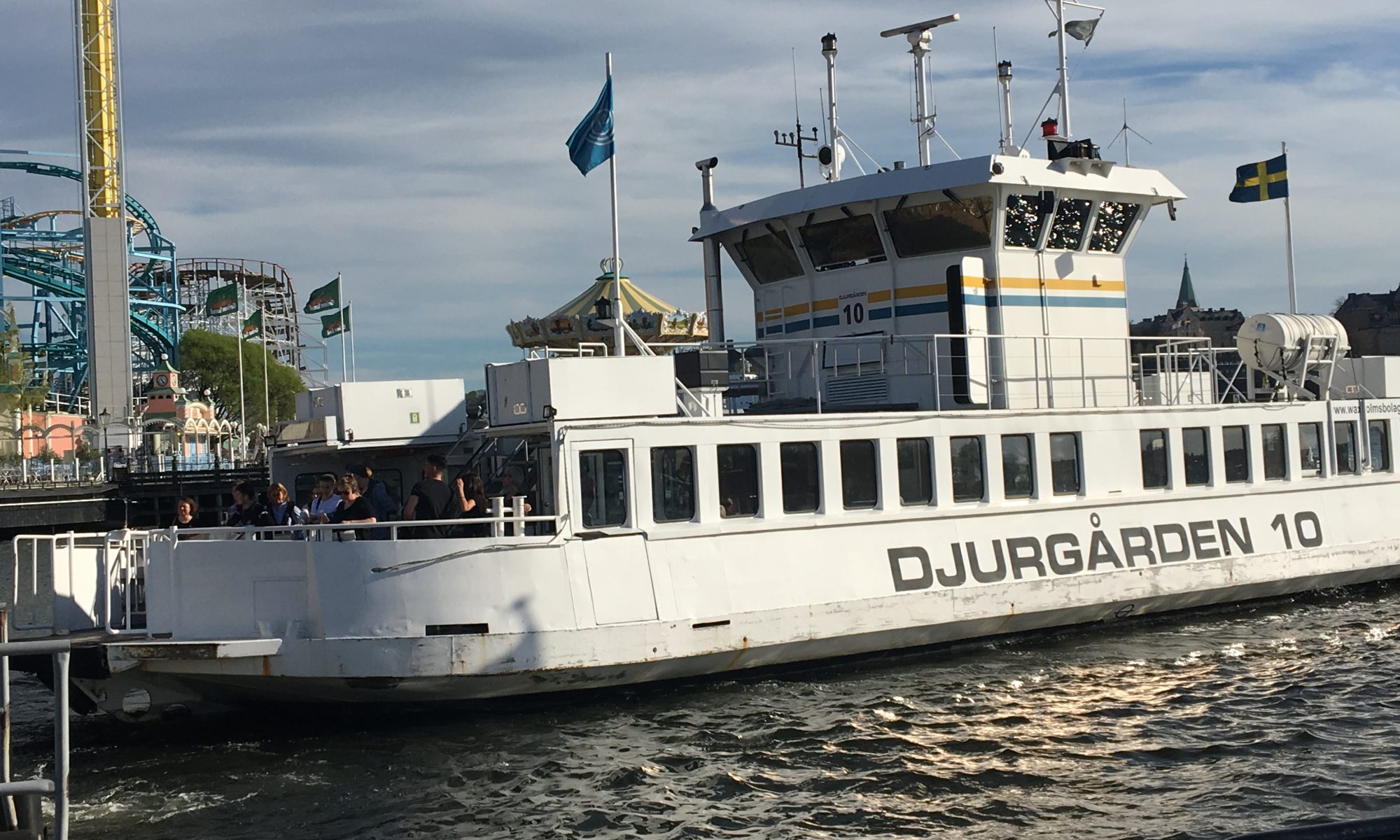
Today, the members of the Transport Committee at Stockholm County Council received an open letter asking for all-electric public transport at Djurgården. Royal Djurgården and Fossil-free Sweden are the main drivers, and have put forward a demand to look into the possibility of electric ferries, as well as how the ferry port at Slussen can be made into an important symbol of a sustainable city.
28th June 2018 – Open letter to the Transport Committee at Stockholm County Council
Revamp the Djurgården Ferry and give Royal Djurgården all-electric public transport.
After the summer, there will be a direct tram line between Djurgården and Stockholm city centre. With this, Scandinavia’s #1 attraction, which draws 15 million visitors per year – more than the Great Wall of China and Disneyland Paris – will have a high-capacity, accessible and environmentally-friendly public transport link. We want to give the Djurgården Ferry a boost, too, and in the long run give Djurgården all-electric public transport.
Improvements to the Djurgården ferries are starting to take shape; they now have better accessibility and more modern and environmentally-friendly features. With the new ferry port being built at Slussen, it is of the utmost importance that the ferry route is built with long-term sustainability in mind.
With its unique combination of culture and entertainment, parks and nature, Djurgården can be a leading example for a sustainable Stockholm and a fossil-free Sweden. An important step, therefore, is to make public transport fossil-free and the ferries all-electric.
The Djurgården Ferry turned 120 years old last year, and is probably Sweden’s most famous ferry route – it already takes close to three million passengers to and from Djurgården today. All of the prerequisites for investing in electric ferries are in place; now all we need is a positive decision!
If Sweden is to reach its goal of reducing greenhouse gas emissions from domestic transport by 70% by 2030, we need to use our scarce resources as best we can. The battle for biofuels will increase once lorries, planes, boats etc. begin switching to new fuels. Therefore, it is important that electrical energy is used where possible, and especially in areas and on routes where it can have a real impact.
On ferry routes that are shorter and have a set route, such as the Djurgården Ferry, it is easy to adjust the battery size and charging time. This would have a positive effect on the climate, but also in the local area, as it would reduce emissions and noise levels. Since 2014, electric ferries have been trialled on two routes: between Nybroplan and Kvarnholmen and between Solna Strand and Riddarholmen. The latter has reduced carbon dioxide emissions by 300 tonnes per year and cut operating costs by 40%.
Therefore, we are asking the council to look into electric ferries for Djurgården, as well as how the ferry port at Slussen can become an important symbol for a sustainable city.
Djurgården is Scandinavia’s #1 attraction, which draws 15 million visitors per year – more than the Great Wall of China and Disneyland Paris, for example. The Royal Djurgården Society works with Djurgården’s attractions to reach common goals and preserve and develop Djurgården’s unique features.
Sustainability is at the heart of what we do and a key part of managing visitor numbers. At Djurgården, it is possible for the island’s rich history and modern, environmentally-friendly technological advances to coincide. We want to promote and showcase the ideas that will make Sweden one of the world’s first fossil-free countries, as we did at the Stockholm World Fairs that took place at Djurgården in 1897 and 1930.
Djurgården’s attractions are already in the process of reducing their use of fossil fuels; Skansen’s horse manure is used by Rosendal’s Garden in their biodynamic farming, for example. We welcomed the extension of the tramline from Djurgården to Stockholm’s central station, as well as the county council’s decision to look into the transition to electric buses.
We now have an historic opportunity to take another step towards a more sustainable Stockholm and Djurgården. We urge the county council to seize this unique opportunity to make Djurgården’s public transport all-electric and ensure that the world’s first National City Park is a leading example in sustainable transport.
If you want to read more about our work with sustainability, visit sustainable.royaldjurgarden.se/en
John Brattmyr
Skansen CEO, Chairman for the Royal Djurgården Society
Camilla Zedendahl
Royal Djurgården Society CEO
Svante Axelsson
National coordinator for Fossil-free Sweden

Royal Djurgården works with other organisations to bring electric public transport to Djurgården (17.17)
 Royal Djurgården takes a leading role in reducing CO2 emissions from public transport (13.2)

Royal Djurgården works with others to reduce the city’s environmental impact (11.6)

Royal Djurgården works with others to build a sustainable infrastructure (9.4)
