The Maritime Museum becomes Sweden’s first partner institution to the UN Decade of Ocean Science initiative

Sjöhistoriska museet

Some great news from the Maritime Museum, which will be the first institution in Sweden to partner with the UN’s ‘Decade of Ocean Science for Sustainable Development’ initiative. Sustainability issues related to our oceans will also be the focal point for the museum’s new online series ‘Studio Sjöhistoriska’, which will feature live expert talks. The series starts on 1st March and will run throughout the spring.

The United Nations Decade of Ocean Science for Sustainable Development began on 1st January this year, and will continue until 2030. The aim of the partnership is for the museum to be a meeting place for industry experts, relevant authorities, civil society organisations and the public, who will contribute to increasing awareness and provide different perspectives on sustainability related to the marine environment and maritime history. It will also be a platform for the museum to strengthen its contribution to the UN’s 2030 Agenda for Sustainable Development and Goal 14, which is to ‘conserve and sustainably use the oceans, seas and marine resources for sustainable development’.

‘Climate change is one of humanity’s greatest challenges, and it threatens marine environments in particular. How we act on this threat over the next ten years will have a decisive impact on limiting the long-term effects. With Studio Sjöhistoriska, we want to help increase awareness about the importance of the sea and the threats it is facing, but also highlight solutions’, says Mats Djurberg, Museum Director at the Maritime Museum.

Climate, the environment and the future of our oceans are comprehensive topics, and the talks will extend over several episodes. The series’ first guests will be Lisa Svensson, former Ocean Ambassador for Sweden and Director of Oceans at the UN; Oskar Kihlborg, explorer, lecturer and photographer; and Petra Wallberg, Research Officer at FORMAS, the Swedish Research Council for Sustainable Development. Museum Director Mats Djurberg will lead the talk.

Life below water

Studio Sjöhistoriska will increase awareness about sustainability and the marine environment


Studio Sjöhistoriska will be streamed live on the museum’s Facebook page on 1st March at 13:00 (in Swedish).
The episode will also be available to watch afterwards on the museum’s website and YouTube channel.

Read more about the UN’s initiative and Sustainability Goal 14.

Contact
Mats Djurberg, Museum Director at Sjöhistoriska museet
Phone: 08-519 549 75
Email: mats.djurberg@smtm.se

If you want to read more about our work with sustainability, visit sustainable.royaldjurgarden.se/en/home-en

Princess Estelle Cultural Foundation announces this summer’s exhibition at Royal Djurgården

två killar, böcker

Following the success of last year’s widely-acclaimed exhibition, ‘Alice Aycock at Royal Djurgården’, we are now getting ready for this summer’s exhibition at Royal Djurgården, which will be by artist duo Elmgreen & Dragset. The main piece is a near eight-metre high site-specific sculpture, which has been acquired by the foundation and will be included in the future sculpture park in the Rosendal area.

Since the start of Michael Elmgreen and Ingar Dragset’s collaboration in 1995, they have had a distinguished international career, and they are among the most significant and multifaceted artists of our time.

Elmgreen & Dragset often refer to everyday objects in their artwork, and they explore what happens when these objects are placed in new unlikely constellations and contexts. With a mixture of absurdist humor and social concern, the artist duo encourages the viewer to reflect and to reconsider habitual interpretations.

”We are really looking forward to presenting Elmgreen & Dragset outdoors at Royal Djurgården this summer. They have a unique ability to portray important topics in an unexpected and surprising way”, says Sara Sandström Nilsson, Executive Director at the Princess Estelle Cultural Foundation.

Elmgreen & Dragset’s exhibition will be the second arranged by the Princess Estelle Cultural Foundation. The exhibition will be unveiled on 8th June.

Read the press release here.

We celebrate more than just Sweden’s National Day at Royal Djurgården!

norges nationaldag

Ever since 1893, Sweden’s National Day has been celebrated at Skansen at Royal Djurgården in the presence of the Swedish royal family, with music, ceremonial speeches and plenty of flags. As a result of the current pandemic, this 127-year-old tradition was broken in 2020. But we have been able to adapt such that we can still celebrate in new and creative ways.

Here at Royal Djurgården, everyone is welcome. And we celebrate not only the Swedish National Day but all National Days. Read more below about how we celebrate some other National Days here at Royal Djurgården and how you can be part of the celebrations in 2021!

Sami National Day – 6th February

The Sami people are one of the world’s indigenous peoples and the only ones in Europe. The date for the national day comes from the fact that the first Sami national meeting was held in Trondheim on 6th February 1917. In Sweden, the day has been a flag day for a few years now.

The Sami National Day has been celebrated at Skansen since 2003. As part of the celebrations, you can visit the Såekie family’s holiday home in Saemien Sïjte and listen to Sami fairytales and myths while huddled around the fire. You can also try your hand at lasso throwing and learn more about reindeer. In the forest house, there are usually craft activities and film screenings about the Sami people’s relationship with modern-day Sweden.

Ahead of the Sami National Day 2021, you can discover and learn more about Sami culture and history via Nordiska museet‘s digital museum! Did you know that the museum’s new entrance, Two Directions, is inspired by objects from the museum’s Sami collections? This year at Skansen, the celebrations will be via their website, where you can hear stories about Sami history and culture.

Chaharshanbe Suri – 20th March

eld

This Persian festival is a popular non-religious holiday that has been celebrated in a number of different countries for almost 4,000 years. In Persian, the festival is called Chaharsahanbe Suri. Just like the Swedish traditional Walpurgis Night celebration, the change of nature is greeted with bonfires, to celebrate winter ending and spring starting, meaning the sun and light are returning.

Stockholm’s celebrations take place with an annual folk festival. The festival is a celebration of diversity and integration, and it took place at Skansen at Royal Djurgården for the first time in 2019. It took place on the Solliden stage and featured a star-studded line-up, which was broadcast on TV across different parts of the world.

Norway’s National Day – 17th May

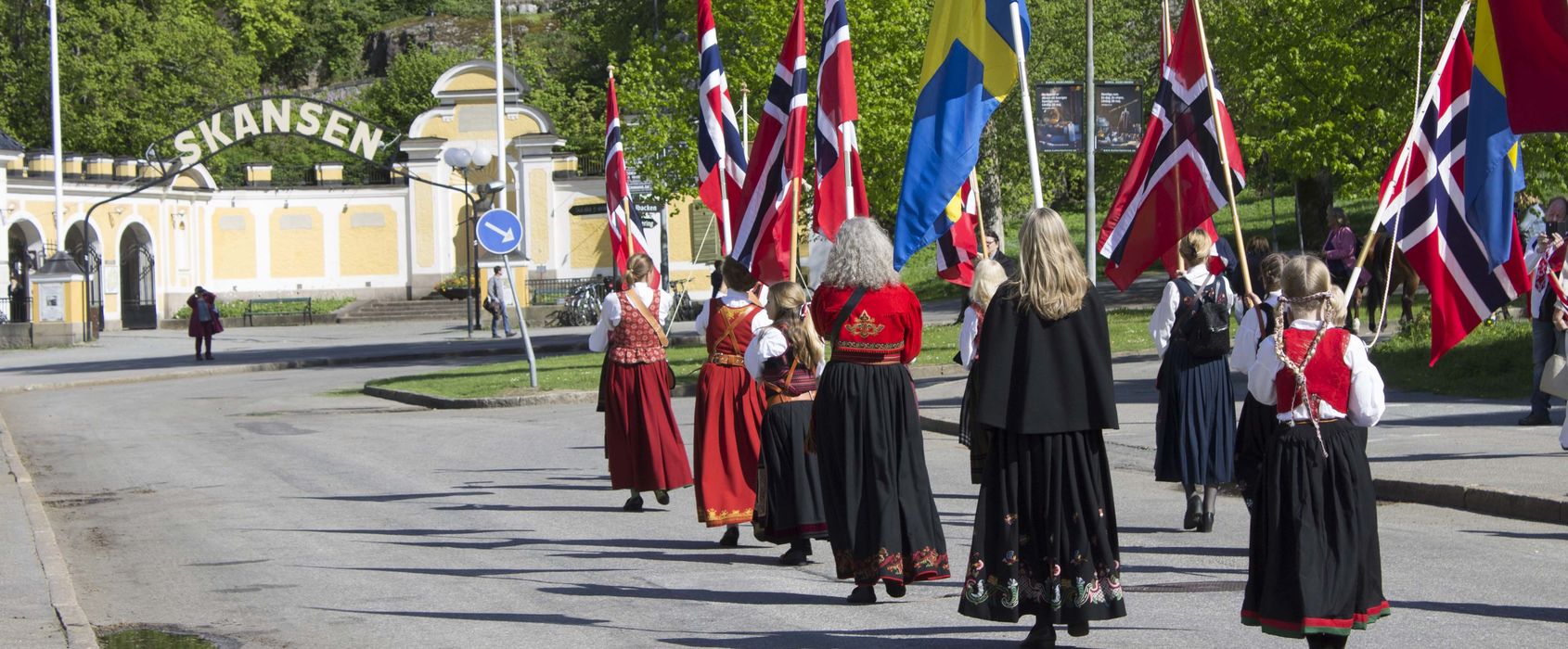
flaggor, folk

Norway’s National Day – Syttende mai – is celebrated in style, not only in Norway but also at Royal Djurgården. We celebrate the National Day on the Solliden stage at Skansen, and the celebrations feature Norwegian folk costumes, Norwegian flags and activities for children and adults.

There is also the opportunity to visit Vastveitloftet, Skansen’s only Norwegian building. It was moved here before 1905, when the union between Sweden and Norway ended. You can’t go inside but the outside is well worth a visit!

Reduced inequalitiesSkansen’s various National Day celebrations promote social inclusion (10.2)


If you want to read more about our work with sustainability, visit sustainable.royaldjurgarden.se/en

All about the Swedish Semla

semla

Most countries mark Shrove Tuesday with pancakes, others with doughnuts, but in Sweden it’s all about the semla bun.

First things first, what is a semla?

A semla (singular) is a wheat flour bun with the centre scooped out, flavoured with cardamom and filled with almond paste and whipped cream, then dusted with icing sugar.

Originally, a semla was simply a bun, eaten soaked in hot milk (known as hetvägg).

What’s the story?

Semlor (plural) are traditionally eaten on Shrove Tuesday, known as Fettisdagen (literally ‘Fat Tuesday’). Back in the day, the buns would be eaten as part of a final celebratory feast before Lent began. The Swedish King Adolf Fredrik went all out at the feast he attended in 1771, to the extent that his cause of death was severe indigestion – presumably caused by the fact that he concluded a lavish meal with 14 hetvägg.

In keeping with Swedes’ love for rules and regulations, it used to be illegal to serve semlor ‘out of season’ (genuinely). But as with many seasonal food trends, they now stick around for as long as possible, and you’ll find semlor in bakery windows from Christmas to Easter.

Branching out

As if the original semla wasn’t enough, many bakeries now like to come up with new, trendy takes on the standard semlor; be it Nutella or blueberry, or even a hybrid of two of Sweden’s most beloved pastries, such as prinsesstårta (Princess cake) or kanelbulle (cinnamon bun) semlor.

blåbärssemlor

Semlor at Royal Djurgården

Royal Djurgården is home to some of Stockholm’s best semlor! At Rosendal’s Garden they use organic ingredients to make their homemade almond paste and whipped cream. And if you want to branch out and try a different flavour, Café Monika Ahlberg bakes her famous blueberry semlor.

Make sure not to miss tasting this delicious Swedish delicacy!